Middle Class Women's Fashion in the 1920s

Canadian Abode Journal, 1920

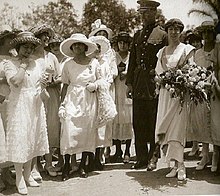
Brazilian women salute Belgian monarchs on their arrival in Belo Horizonte, Brazil. 2 October 1920
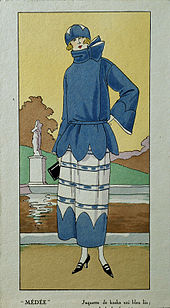
A drawing picturing French women's fashion, c.1921

Tennis player, Australia 1924
Western mode in the 1920s underwent a modernization. For women, manner had connected to change abroad from the extravagant and restrictive styles of the Victorian and Edwardian periods, and towards looser habiliment which revealed more than of the arms and legs, that had begun at to the lowest degree a decade prior with the rising of hemlines to the ankle and the move from the S-bend corset to the columnar silhouette of the 1910s. Men likewise began to wear less formal daily attire and athletic clothing or 'Sportswear' became a function of mainstream fashion for the showtime time. The 1920s are characterized past two distinct periods of fashion: in the early part of the decade, change was slower, and there was more reluctance to wear the new, revealing pop styles. From 1925, the public more than passionately embraced the styles now typically associated with the Roaring Twenties. These styles continued to characterize fashion until the worldwide depression worsened in 1931.
Overview [edit]
After Earth State of war I, the United states entered a prosperous era and, as a effect of its role in the war, came out onto the world stage. Social community and morals were relaxed in the optimism brought on by the end of the state of war and the booming of the stock market. Women were inbound the workforce in tape numbers. In the United States, at that place was the enactment of the 18th Amendment, or equally many know it, Prohibition, in 1920. Prohibition stated that it would be illegal to sell and consume alcohol. This lasted until 1933, and then it was a abiding for the whole 1920s era. They instilled this "noble experiment" to reduce criminal offence and abuse, solve social problems, reduce the revenue enhancement brunt created by prisons and poorhouses, and improve health and hygiene. The nationwide prohibition on alcohol was ignored by many resulting in speakeasies. Some other important amendment in the United States was the 19th Amendment, which gave women the correct to vote. There was a revolution in almost every sphere of human action. Fashion was no exception; women entered the workforce and earned the right to vote, and they felt liberated. Fashion trends became more accessible, masculine, and practical, creating the emergence of "The New Adult female". Flappers was a popular proper noun given to women of this time because of what they wore. The constrictive corset, an essential undergarment to make the waist thinner, became a matter of the past.[1]
The evolution of new fabrics and new means of fastening clothing affected fashions of the 1920s. Natural fabrics such every bit cotton and wool were the arable fabrics of the decade. Silk was highly desired for its luxurious qualities, only the limited supply made information technology expensive. In the late 19th century, "artificial silk" was first fabricated in France, from a solution of cellulose. After existence patented in the U.s.a., the first American found began production of this new fabric, in 1910. This fiber became known as rayon. Rayon stockings became popular in the decade equally a substitute for silk stockings. Rayon was besides used in some undergarments. Many garments before the 1920s were fastened with buttons and lacing. However, during this decade, the evolution of metal hooks and eyes meant that in that location were easier means of fastening clothing. Hooks and optics, buttons, zippers, and snaps were all used to spike clothing.
Vastly improved production methods enabled manufacturers to easily produce clothing affordable by working families. The average person'southward fashion sense became more sophisticated. Meanwhile, working-class women looked for modern forms of dress as they transitioned from rural to urban careers. Taking their cue from wealthier women, working women began wearing less expensive variations on the day conform, adopting a more than modern look that seemed to conform their new, technologically focused careers equally typists and telephone operators.[2]
Although uncomplicated lines and minimal adornment reigned on the runways, the 1920s were not gratuitous of luxury. Expensive fabrics, including silk, velvet, and satin were favored by loftier-terminate designers, while section stores carried less expensive variations on those designs made of newly available constructed fabrics. The use of mannequins became widespread during the 1920s and served as a mode to show shoppers how to combine and accessorize the new fashions. The mod way cycle, established in the 1920s, still dominates the industry today. Designers favored separates in new fabrics like jersey that could be mixed and matched for piece of work and modernistic, informal, united nations-chaperoned social activities like attending films or the theater and car rides.[2]
Women's wear [edit]
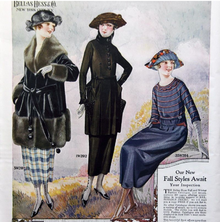
Bellas Hess and Company annunciate detail, 1920

By early 1920s, most women non dared to bob their hair, so they pinned upwardly to look shorter. Mlle Cayet, Queen of Parisian Funfair, 1922

Between 1922 and 1923, the waistline dropped to the hips. The 1920s archetype tubular fashion was built-in. Parisian fashion business firm Madeleine-et-Madeleine pattern, Jan, 1922.
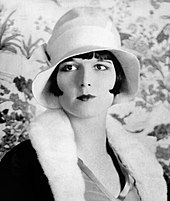
Paris set the fashion trends for Europe and North America.[3] The way for women was all about letting loose. Women wore dresses all solar day, every day. Day dresses had a drop waist, which was a belt around the depression waist or hip and a skirt that hung anywhere from the talocrural joint on upwardly to the knee, never above. Daywear had sleeves (long to mid-bicep) and a brim that was straight, pleated, hank hem, or tiered. Hair was often bobbed, giving a boyish await.[four]
Wearable fashions changed with women's changing roles in society, particularly with the idea of new fashion. Although society matrons of a certain age continued to wear conservative dresses, the sportswear worn by forrad-looking and younger women became the greatest alter in postal service-state of war fashion. The tubular dresses of the 'teens had evolved into a like silhouette that now sported shorter skirts with pleats, gathers, or slits to allow motion. The almost memorable fashion trend of the Roaring Twenties was undoubtedly "the flapper" expect. The flapper dress was functional and flattened the bust line rather than accentuating information technology.[1]
The directly-line chemise topped by the shut-plumbing fixtures cloche hat became the uniform of the twenty-four hours. Women "bobbed", or cutting, their hair brusque to fit under the popular hats, a radical motility in the showtime, but standard past the end of the decade. Depression-waisted dresses with fullness at the hemline allowed women to literally kick up their heels in new dances like the Charleston. In 1925, "shift" blazon dresses with no waistline emerged. At the cease of the decade, dresses were being worn with straight bodices and collars. Tucks at the bottom of the bodices were popular, besides as knife-pleated skirts with a hem approximately i inch beneath the articulatio genus.[5]
In the world of art, fashion was being influenced heavily by art movements such as surrealism. Elsa Schiaparelli is 1 primal Italian designer of this decade who was heavily influenced by the "across the real" fine art and incorporated it into her designs.
Proper attire for women was enforced for morning, afternoon, and evening activities. In the early role of the decade, wealthy women were notwithstanding expected to change from a morning to an afternoon apparel. These afternoon or "tea gowns" were less class-plumbing equipment than evening gowns, featured long, flowing sleeves, and were adorned with sashes, bows, or bogus flowers at the waist. For evening wear the term "cocktail dress" was invented in France for American clientele. With the "New Woman" also came the "Drinking Woman". The cocktail dress was styled with a matching hat, gloves, and shoes. What was so unique nearly the cocktail clothes was that it could exist worn not merely at cocktail hours (half-dozen and 8pm), simply past manipulating and styling the accessories correctly could exist worn accordingly for whatsoever event from 3 pm to the tardily evening. Evening gowns were typically slightly longer than tea gowns, in satin or velvet, and embellished with beads, rhinestones, or fringe.[2]
Accessories [edit]
One of the key accessories in the 20s was the Cloche chapeau. "In 1926 Vogue stated 'The Bob Rules', only nine years after the influential dancer, Irene Castle, cut her hair. This trending topic inspired a 1920 curt story past F. Scott Fitzgerald, called Bernice Bobs Her Hair, and many editorials in Vogue throughout the decade."[6] The bob hairstyle matched perfectly with the loose and straight silhouette of the times. During this era Vogue gave credit to this new cut for the immense success of the chapeau business. New haircuts meant new styled hats, therefore there was a new craze for hats. The cloche hat and the bob were basically made for each other.
Jewelry was less conspicuous.[7] Jewelry was much less elaborate, and began using 'romantic', more natural shapes. The Fine art Nouveau movement of 1890-1910 inspired well-nigh of the natural forms and geometric shapes of the jewelry during the 1920s. "Aesthetic clean lines were inspired past designs found in industrial machines. A central influence of this modernism was the influential Bauhaus movement, with its philosophy of form following function. Contrasting textures and color were likewise in fashion. Examples of changing tastes in blueprint were the utilise of diamonds being gear up against onyx or trans lucid vitrines and amethysts juxtaposed confronting opaque coral and jade."[8] Even though geometric shapes and cleaner shaped jewelry were now a trend, one of the primal pieces was the long rope pearl necklace. The long rope pearl necklace was a signature faux piece that was sold everywhere at the time. It was inexpensive and bones in a woman'south wardrobe. "Although buffeted past cycles of boom, depression and war, jewelry design between the 1920s and 1950s continued to be both innovative and glamorous. Sharp, geometric patterns celebrated the motorcar age, while exotic creations inspired by the Nearly and Far East hinted that jewelry fashions were truly international."[9]
Shoes were finally visible during the 1920s. Before, long garments covered up shoes, and so they weren't an important part of women'due south way. At present, shoes were seen past everyone and played an important part during the 1920s. Women had all kinds of shoes for all kinds of events. Everything from house shoes, walking shoes, dancing shoes, sporting shoes, to pond shoes. The shoe industry became an important industry that transformed the way we buy shoes today. Shoes were made in standard sizes perfect to club from fashion catalogs to the near boutique. In the beginning of the 1920s, Mary Janes were still popular from previous era, although they paved the fashion for the invention of many other shoes. The T-strap heel was a variation of the Mary Jane, having the aforementioned base with the addition of a strap going effectually the heel and downwardly to the top of the shoe that looked like a T. Also, "The bar shoe which fastened with a strap and a unmarried push became popular during the 1920s. It was worn with the new short skirts and was practical for their vigorous way of dancing."[10]
The influence of jazz [edit]
"The Jazz Age", a term coined by F. Scott Fitzgerald, was a phrase used to stand for the mass popularity of jazz music during the 1920s.[11] Both jazz music and trip the light fantastic marked the transition from the archaic societal values of the Victorian era to the arrival of a new youthful modern society. Jazz gained much of its popularity due to its perceived exoticism, from its Afro-American roots to its melodic and soulful rhythm. The music itself had quite an alluring outcome on the new youthful order and was considered to exist the pulse of the 1920s due to its spontaneity. With new music emerged new dancing. Jazz dances, such as the Charleston, replaced the slow flit. Paul Whitman popularized jazz trip the light fantastic. In fact, jazz music and dance are responsible for the origin of the iconic term "flapper", a grouping of new socially unconventional ladies. When dancers did the Charleston, the fast movement of the anxiety and swaying of the arms resembled the flapping movements of a bird.[xi] Jazz music sparked the need to dance, and trip the light fantastic sparked the demand for new clothing, specially for women to easily dance without being constricted.
Dances such as the Charleston and the Blackness Bottom in particular created a need for a revival in women'due south evening wear due to the dynamic and lively manner of these jazz dances. Clothes and skirt hems became shorter in order to allow the body to move more easily. In addition, decorative embellishments on dresses such as fringe threads swung and jingled in sync with the movement of the torso. Lastly, the use of glossy and ornate textiles mirrored light to the tempo of jazz music and dance.[12] Jazz music and its perceived exotic nature had both a flamboyant influence on fashion while keeping both class and function in mind.
Jazz and its influence on way reached even farther, with both jazz and dance motifs making their way onto textiles. These new textile designs included uneven repetitions and linear geometric patterns. Many textile patterns produced in the Usa also incorporated images of both jazz bands and people dancing to jazz.[13] The print Rhapsody shows a textile produced in 1925 representing a jazz ring in a polka-dot similar style.[14] Not only did textiles take motifs of people dancing and playing jazz music, they included designs that were based on the overall rhythmic feel and sound of jazz music and trip the light fantastic.
The boyish effigy [edit]
Undergarments began to transform after World State of war I to conform to the ethics of a flatter breast and more than boyish figure. The female figure was liberated from the restrictive corset, and newly popular the adolescent look was achieved through the use of bosom bodices. Some of the new pieces included chemises, thin camisoles, and cami-knickers, later on shortened to panties or knickers. These were primarily made from rayon and came in soft, light colors in order to exist worn nether semi-transparent fabrics.[15] Young flappers took to these styles of underwear due to the ability to move more freely and the increased comfort when dancing to the high tempo jazz music. During the mid-1920s, all-in-one lingerie became popular.
For the first time in centuries, women'due south legs were seen with hemlines ascension to the knee and dresses becoming more fitted. A more than masculine wait became pop, including flattened breasts and hips, brusk hairstyles such as the bob cut, Eton crop, and the Marcel wave. The fashion was seen as expressing a bohemian and progressive outlook.
1 of the outset women to wear trousers, cutting her hair short, and pass up the corset was Coco Chanel. Probably the about influential woman in fashion of the 20th century, Chanel did much to farther the emancipation and freedom of women'south fashion.
Jean Patou, a new designer on the French scene, began making two-slice sweater and skirt outfits in luxurious wool jersey and had an instant hit for his morning dresses and sports suits. American women embraced the apparel of the designer as perfect for their increasingly agile lifestyles.
By the end of the 1920s, Elsa Schiaparelli stepped onto the stage to stand for a younger generation. She combined the idea of archetype design from the Greeks and Romans with the modern imperative for freedom of movement. Schiaparelli wrote that the aboriginal Greeks "gave to their goddesses... the serenity of perfection and the fabulous appearance of freedom." Her own interpretation produced evening gowns of elegant simplicity. Parting from the chemise, her apparel returned to an awareness of the body below the evening gown.
- Style gallery 1920–25
-
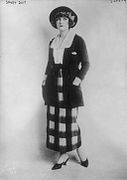
Summer sport arrange, 1920.
-
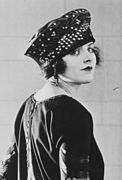
Actress Elaine Hammerstein, 1921. The forehead was usually covered in the 1920s, hither by a hat reaching to the eyebrows.
-

Rolled stockings, 1922.
-

Robe de style, Lanvin, 1922.
-

Dress with a dropped waist and width at the hips, 1923.
-
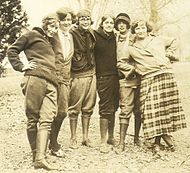
Teenage girls in Minnesota wearing breeches and riding boots with men'due south neckties, 1924.
-

By 1925, skirts concluded simply below the knee. Tunic-tops and sweaters reaching to the hips were popular.
- Mode gallery 1926–29
-

Actress Aileen Pringle wearing a cloche lid and boldly patterned coat, 1926.
-
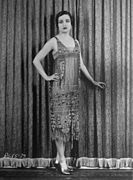
Actress Alice Joyce in a straight dress with a sheer beaded overdress, 1926.
-

A painting showing the mid-decade silhouette at its simplest: languid pose, bobbed pilus, genu-length dress with dropped waist, 1926.
-
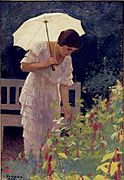
Adult female with Umbrella, Ipolit Strâmbu, 1927. Designers used multiple hemlines (here, tiers of ruffles) to acquaint the middle to longer skirts. This apparel foreshadows the college waist and feminine await that spread to everyday style past the early 1930s.
-

Woman hiding a hip flask tucked in her garter belt during Prohibition, late 1920s.
-

May 1928, abdomen and curves. After many years of a "stovepipe" silhouette, "natural" curves were showtime to reappear.[sixteen]
-

Knee-length, pleated skirts and dropped waists were still pop as everyday clothes in 1929, though Paris designers were already showing longer skirts and higher waistlines.
-
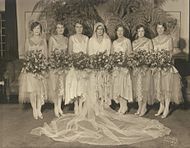
Bridesmaids gowns of 1929 have knee-length underskirts and longer, sheer over skirts, foreshadowing the trend toward longer skirts. Minnesota, 1929.
Menswear [edit]
In menswear, in that location were two distinct periods in the 1920s. Throughout the decade, men wore short adjust jackets, the old long jackets being used merely for formal occasions. In the early 1920s, men'due south style was characterized by extremely high-waisted jackets, oftentimes worn with belts. Lapels on adapt jackets were not very wide as they tended to be buttoned up high. This style of jacket seems to have been greatly influenced by the uniforms worn by the military during the Outset World War. Trousers were relatively narrow and straight and they were worn rather short and so that a homo's socks often showed. Trousers also began to exist worn cuffed at the bottom at this time.
By 1925, wider trousers normally known as Oxford bags came into fashion, while suit jackets returned to a normal waist and lapels became wider and were oft worn peaked. Loose-fitting sleeves without a taper also began to be worn during this period. During the belatedly 1920s, double-breasted vests, oft worn with a unmarried-breasted jacket, as well became quite fashionable. During the 1920s, men had a diverseness of sport clothes available to them, including sweaters and brusque trousers (normally known in American English equally knickers). For formal occasions in the daytime, a morning suit was usually worn. For evening habiliment men preferred the short tuxedo to the tail glaze, which was now seen equally rather old-fashioned and snobby.
Men's fashion too became less regimented and formal. Men favored short jackets with two or 3 buttons rather than jackets with long tailcoats also as pinstriped suits. Casual-wear for men oft included knickers, short pants that came to the genu.[ane] The most formal men'south suit consisted of a blackness or midnight-blue worsted swallow-tailed glaze trimmed with satin, and a pair of matching trousers, trimmed down the sides with wide braid or satin ribbon.[17] A white bow tie, black silk top hat, white gloves, patent leather Oxford shoes, a white silk handkerchief, and a white bloom boutonnière completed the outfit. The tuxedo vest could be black or white, but, different the obligatory full-wearing apparel white tie, tuxedos ties were always black. Men ordinarily completed their tuxedo outfit with even so accessories equally the full-dress suit, except that instead of top hats they would wear dark, dome-shaped hats chosen bowlers. But like women, men had sure attire that was worn for sure events. Tuxedos were appropriate attire at the theater, small-scale dinner parties, entertaining in the domicile, and dining in a restaurant. During the early 1920s, most men's dress shirts had, instead of a collar, a narrow neckband with a buttonhole in both the front and back. By the mid-1920s, withal, many men preferred shirts with attached collars, which were softer and more comfy than rigid, detachable collars.[17]
- Men's hats
Men's hats were usually worn depending on their class, with upper class citizens unremarkably wearing top hats or a homburg hat. Heart-course men wore either a fedora, bowler hat, or a trilby hat. During the summer months, a straw boater was popular for upper class and middle-class men. Working-course men wore a standard newsboy cap or a flat cap.
- Fashion gallery
-

Publisher Edward Beale McLean wearing a three-piece striped adjust with a spread-neckband shirt, 1924.
-
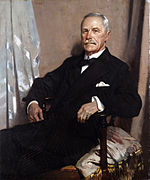
-
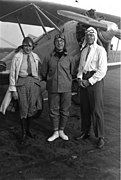
German aviators, one a prince, 1929.
Way influences and trends [edit]
During the 1920s, the notion of keeping upwardly with style trends and expressing oneself through material goods seized heart-class Americans equally never earlier. Purchasing new clothes, new appliances, new automobiles, new anything indicated one'southward level of prosperity. Beingness considered old-fashioned, out-of-engagement, or—worse yet—unable to afford stylish new products was a fate many Americans went to great lengths to avoid.[17]
For women, face up, figure, coiffure, posture, and grooming had become important fashion factors in addition to clothing. In detail, cosmetics became a major industry. Women did not feel ashamed for caring about their appearance and it was a declaration of self-worth and vanity, hence why they no longer wanted to achieve a natural expect. For evenings and events, the popular look was a smoky eye with long lashes, rosy cheeks and a bold lip. To emphasize the eyes, Kohl eyeliner became popular, and was the kickoff time they knew annihilation of eyeliner (data near Egyptian fashion was not discovered until afterwards in the 1920s). Women besides started wearing foundation and using pressed powder. Also, with the invention of the swivel lipstick, lipstick was on the rising with bright colors and they applied their lipstick to attain a cupid's bow and "bee stung" expect.
Glamour was at present an important fashion trend due to the influence of the motion picture industry and the famous female movie stars. Mode, at many social levels, was heavily influenced by the newly created, larger-than-life movie stars. For the first time in history, fashion influences and trends were coming from more than one source.[v] Non unlike today, women and men of the 1920s looked to motion picture stars as their manner icons. Women and men wanted to emulate the styles of Hollywood stars such as Louise Brooks, Greta Garbo, Rudolph Valentino, and Clark Gable.[1]
Work clothes [edit]
For working class women in the 1920s, tailored suits with a directly, curve less cutting were popular. Throughout the decade, the lengths of skirts were ascension to the knee and and so to the ankle various times affecting the skirt style of tailored suits.[18] Rayon, an artificial silk material, was most common for working-class women clothing.[xix]
For working-class men in the 1920s, suits were popular. Depending on the chore title and flavor of the year, the suit would alter.[20] These would have featured high lapels and were frequently made of thick wool material before the advent of central heating.[21]
Children'due south way [edit]
Manner for children started to become more stylish and comfortable in the 1920s. Apparel were made out of cotton wool and wool rather than silk, lace, and velvet. Clothes were as well fabricated more sturdy in order to withstand play. During previous decades, many layers were worn; even so, during the 1920s, minimal layers became the new standard.[22]
For girls, clothing became looser and shorter. Dresses and skirts were now knee length and loose fitting. Shoes were also made out of canvas, making them lighter and easier to wear.[22]
For boys, knee-length trousers were worn all year long and would be accompanied by ankle socks and sail shoes. Pullovers and cardigans were also worn when the weather became libation.[22]
-
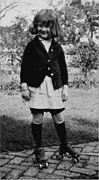
Roller-skater, Mississippi, 1921.
-

Children's fashion, Federal republic of germany, 1925.
See also [edit]
- Cosmetics in the 1920s
- Roaring Twenties
- Flapper
- Interwar period
Notes [edit]
- ^ a b c d Marsha West. Mode Trends of the Twenties. July 1, 2008.
- ^ a b c Fashion in the 1920s (Overview). Pop Culture Universe: Icons, Idols, Ideas. ABC-CLIO, 2011. Retrieved Dec 24, 2012.
- ^ Mary Louise Roberts, "Samson and Delilah revisited: the politics of women's fashion in 1920s France". American Historical Review 98.3 (1993): 657-684.
- ^ Steven Zdatny, "The Adolescent Expect and the Liberated Woman: The Politics and Aesthetics of Women's Hairstyles." Fashion Theory 1.iv (1997): 367-397.
- ^ a b Carol Nolan. "Ladies Fashions of the 1920s". Retrieved December 24, 2012.
- ^ "Faddy past the Decade". Faddy.
- ^ Simon Bliss, "'50'intelligence de la parure': Notes on Jewelry Wearing in the 1920s." Fashion Theory xx.1 (2016): 5-26.
- ^ "1920s Jewellery Manner and Inspiration". Winterson.
- ^ "A history of jewellery". Victoria and Albert.
- ^ Sancaktar, Asli. "An Analysis of Shoe Within the Context of Social History of Fashion" (PDF).
- ^ a b Langley, Susan (2005-09-28). Roaring '20s Fashions: Jazz. Atglen, PA: Schiffer Publishing. ISBN9780764323195.
- ^ Hannel, Susan L. (2005). "four The Influence of American Jazz on Fashion". Twentieth-Century American Style. Dress, Torso, Civilization. doi:10.2752/9781847882837/tcaf0008. ISBN9781847882837.
- ^ Hannel, Susan Fifty. (2002). The Africana craze in the Jazz Age : a comparison of French and American fashion, 1920-1940 / (Thesis). [ permanent dead link ]
- ^ "Textile, Americana Print: Rhapsody, 1925". Cooper Hewitt, Smithsonian Pattern Museum . Retrieved 2017-10-09 .
- ^ Thornton, Zita (2011). Fashion for a Jazz Age. Chicago, IL: Lightner Publishing Corp. p. 39.
- ^ "Back to Dazzler". The Spirella Magazine. May 1928. p. 72.
- ^ a b c Bob Batchelor. "Mode in the 1920s". American Pop: Popular Culture Decade by Decade, Volume 1: 1900–1929. Greenwood Printing, 2009. pp. 292-302.
- ^ Vermont, Jens Hilke, University of. "Women'southward Article of clothing - 1920s - Clothing - Dating - Mural Change Program". www.uvm.edu . Retrieved 2016-11-fifteen .
- ^ "History of Womens Fashion - 1920 to 1929 | Glamourdaze". glamourdaze.com . Retrieved 2016-xi-15 .
- ^ "What Did Women & Men Vesture in the 1920s?". VintageDancer.com. 2013-06-21. Retrieved 2016-11-15 .
- ^ "1920s Men's Style From Peaky Blinders To Gatsby". The Costume Rag. 2019-12-xiii. Retrieved 2019-12-17 .
- ^ a b c "1920 Children's Style Facts". LoveToKnow . Retrieved 2016-10-17 .
Further reading [edit]
- Arnold, Janet: Patterns of Manner ii: Englishwomen's Dresses and Their Construction C.1860–1940, Wace 1966, Macmillan 1972. Revised metric edition, Drama Books 1977. ISBN 0-89676-027-8
- Blackness, J. Anderson, and Madge Garland, A History of Fashion, New York, Morrow, 1975
- Boucher, François: twenty,000 Years of Way, Harry Abrams, 1966.
- Laver, James: The Curtailed History of Costume and Fashion, Abrams, 1979.
- Nunn, Joan: Fashion in Costume, 1200–2000, 2nd edition, A & C Black (Publishers) Ltd; Chicago: New Amsterdam Books, 2000. (Excerpts online at The Victorian Web)
- Russell, Douglas A. " Costume History and Style" Stanford University, 1983.
- Steele, Valerie: Paris Fashion: A Cultural History, Oxford Academy Press, 1988, ISBN 0-19-504465-vii
- Steele, Valerie: The Corset, Yale University Press, 2001
- The Spirella Magazine; MAY 1928
- Children's fashion of the 1920s
External links [edit]
- 1920s Fashion Plates of men, women, and children'due south way from The Metropolitan Museum of Fine art Libraries
- Photographs from the 1920s taken by photographer, Henry Walker at the Academy of Houston Digital Library
- "1920s - 20th Century Fashion Drawing and Illustration". Way, Jewellery & Accessories. Victoria and Albert Museum. Archived from the original on 2011-01-08. Retrieved 2011-04-03 .
0 Response to "Middle Class Women's Fashion in the 1920s"
Post a Comment